POLITICO
As a policy intern at POLITICO, I worked with their education team and pitched enterprise stories, covered breaking news and contributed to their daily newsletter. I helped boost the team’s artificial intelligence and technology coverage and leaned on my experience in immigration reporting. I also covered lawsuits, civil rights investigations and congressional hearings.

Immigration
-
Published 02/26/2026 01:32 PM EST on POLITICO Pro
A Columbia University student detained by Department of Homeland Security agents Thursday morning has been released
after New York City Mayor Zohran Mamdani directly appealed to President Donald Trump.
The detainment alarmed local lawmakers and campus officials after the agents allegedly misrepresented their intentions as searching for a missing child to gain access to the student's off campus residence.
Acting President Claire Shipman said Thursday evening that the agents entered without any kind of warrant and the school's security cameras captured them showing pictures of the allegedly missing child.
“Let me be clear, misrepresenting identity and other facts to gain access to a residential building is a breach of protocol," she said in the video statement. "All law enforcement agencies are obligated to follow established legal ethical standards.”
Ellie Aghayeva, who has since been confirmed as the student who was detained, said Thursday afternoon via an Instagram story that she has been released.
“I just got out a little while ago. I am safe and okay,” she said.
A DHS spokesperson said in a statement she was no longer a student.
“ICE arrested Elmina Aghayeva, an illegal alien from Azerbaijan, whose student visa was terminated in 2016 under the Obama administration for failing to attend classes," the spokesperson said.
"Homeland Security Investigators verbally identified themselves and visibly wore badges around their necks. The building manager and her roommate let officers into the apartment. She has no pending appeals or applications with DHS. [Immigration and Customs Enforcement] placed her in removal proceedings and she's been released while she waits for her hearing."
The university hasn't reported a detainment since the high-profile case of Mahmoud Khalil, a pro-Palestinian activist who was detained by ICE from his university-owned residence, last March.
The Trump administration last year reversed a long-standing policy that protected “sensitive spaces” like schools from immigration enforcement actions. In place of legal protections, universities and K-12 school systems have been forced to make their own decisions on how to manage immigration enforcement presence on campus.
Columbia University's policy requires that law enforcement must have a judicial warrant or judicial subpoena to access non-public parts of the campus, including housing, classrooms and any spaces requiring a security pass. With entry requests to non-public areas, agents must contact the campus' Public Safety office, which in turn notifies the Office of General Counsel to determine a response, Shipman said.
Shipman added that "Nobody in our administration has ever provided any assistance to DHS or ICE in regard to arresting or taking any of our students. Quite the opposite. We have labored, often intensively, behind the scenes, to see them supported.”
A White House spokesperson could not be reached for comment.
“ICE has no place in our schools and universities," New York City Council Speaker Julie Menin and Majority Leader Shaun Abreu said in a joint statement on X. "These activities do not make our city or country safer, but rather drive mistrust and danger. As Columbia College alumni, our hearts are with the community there, and we have been in contact with the University to offer our assistance."
"Let's be clear about what happened: ICE agents didn't have the proper warrant, so they lied to gain access to a student's private residence. I've proposed a bill that would ban ICE from entering sensitive locations like schools and dorms. Let's get it passed now," New York Governor Kathy Hochul said in an X post, referencing legislation proposed this January.
Jack Schlossberg, grandson of former President John F. Kennedy and a Democratic candidate running for Congress, also denounced the federal agents' actions and their alleged misrepresentation of searching for a missing person as a reason for entry.
Following a White House meeting between Trump and Mamdani Thursday afternoon on housing development in the city, the mayor confirmed that he expressed concerns about the detained student directly to Trump.
"Just got off the phone with President Trump. In our meeting earlier, I shared my concerns about Columbia student Elaina Aghayeva, who was detained by ICE this morning. He has just informed me that she will be released imminently," posted Mamdani on X.
Aghayeva, a social media influencer and neuroscience student, expressed gratitude for her release via her Instagram account.
According to a report by the Columbia Spectator, the university's newspaper, the detainment comes a day after Student Workers of Columbia-United Auto Workers held an “ICE Off Campus” rally to demand greater protections and for the university to establish itself as a sanctuary campus.
-
Published on 03/18/2026 05:44 PM EDT on POLITICO Pro
Republicans pushing for the Supreme Court to overturn its decision guaranteeing access to education for undocumented students mulled what a successful challenge to the landmark decision could look like, drawing sharp rebukes from Democratic lawmakers.
Members of the House Judiciary Subcommittee on the Constitution and Limited Government on Wednesday sparred over the requirements under Plyler v. Doe. The high court ruled in the 1982 case that denying undocumented students the right to attend public school violated the equal protection clause of the 14th Amendment.
Red states have begun to push legislation targeting undocumented students.
Conservative lawmakers and organizations like The Heritage Foundation hope these moves will trigger an opening for the conservative-leaning Supreme Court to weigh in on the more than 40-year-old ruling.
“It's time for it to go,” Freedom Caucus member and subcommittee Chair Chip Roy (R-Texas) said in his opening remarks.
Republicans blamed the ruling for encouraging more immigrants to enter the country illegally, an increase that they claim burdens local economies. They say the issue could be alleviated if the students were barred from schools, citing requirements that schools with limited resources have to provide assistance for students who are English learners.
“I understand the need to want to help others, but oh my gosh, what about our own American citizens that are tax-paying Americans right here, right now, that should be put in first place?” said Rep. Wesley Hunt (R-Texas).
A majority of the Democratic subcommittee members argued that overturning Plyler would actually have negative economic consequences nationally and in their own states.
“It's a cruel attempt to senselessly punish undocumented children for their parents' decisions, choices they had no role in, and it's all based on a false assertion that giving undocumented children a public education is a burden on taxpayers,” said ranking member Mary Gay Scanlon (D-Pa.).
To advance restrictions around undocumented students' access to schools, Republicans highlighted a recent Tennessee bill to track the immigration status of K-12 students enrolled in schools across the state. They speculated what the advantages could be in encouraging similar state proposals tracking the impact of undocumented students on American taxpayers.
Committee members noted that this type of proposal would challenge an Obama-era directive restricting this data.
“I think we're entitled to ask how our public schools have fared. Since this is the largest illegal mass migration in history under the Democrats, are students doing better or worse?” said Rep. Thomas Massie (R-Ky.)
James Rogers, a senior counselor with the America First Legal Foundation, a conservative legal entity, argued that the 2022 Dobbs decision that overruled Roe v. Wade's abortion rights guarantee could set the framework for reversing Plyler.
All five factors Dobbs set on whether a prior precedent could be reevaluated could apply to Plyler, he said during his testimony — a claim backed by panel Republicans.
Scanlon, backed by fellow Democrats on the subcommittee, voiced concerns that endingPlyler's protections could have future consequences for challenges that could come to other demographic groups, including students with disabilities who also require extra resources and funding.
"If we accept the argument that immigration status can be used as a reason to deny public education, where does that logic stop?" she said.
-
Published on 01/27/2026 08:16 PM EST for POLITICO Pro
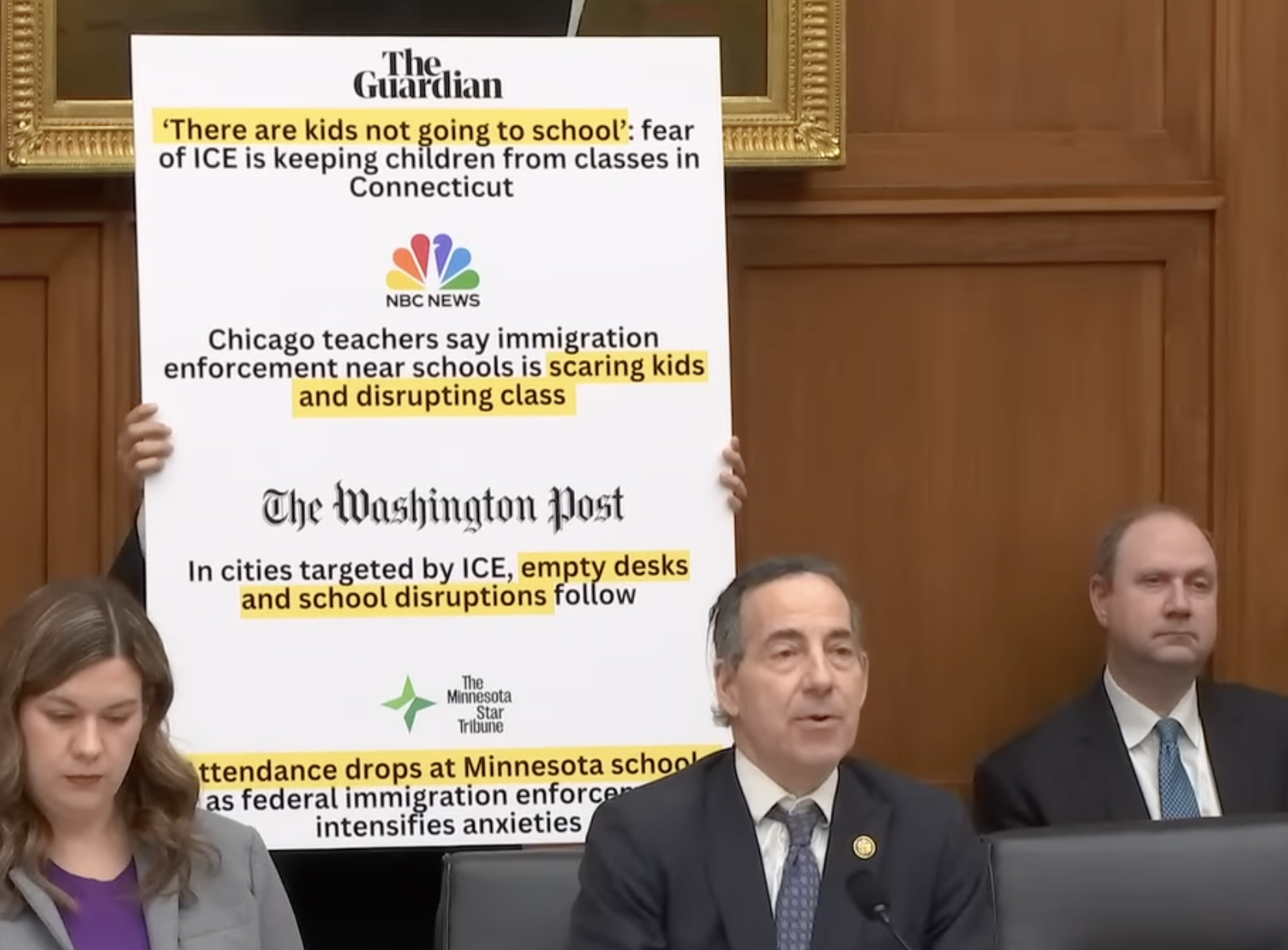
The Trump administration’s massive immigration crackdown in Minnesota is causing attendance to drop to levels not seen since the Covid-19 pandemic for K-12 students, school district officials and local lawmakers say.
The escalating federal presence has heightened safety concerns of students and their families in the Minneapolis-St. Paul area and led local officials to launch online learning options in addition to regular in-person classes.
“We have been nothing but intentional in addressing the mental health challenges, the absenteeism issues, and addressing all of those things that plague our students these past four years,” Mary Kunesh, a Democratic state senator who chairs the education finance committee, said during a Tuesday press conference. “It is very clear that we are right back at ground zero.”
Thousands of immigration agents have flooded the Twin Cities over the past two months, with their presence drawing increased scrutiny after federal law enforcement agents shot and killed Alex Pretti and Renee Nicole Good, both 37-year-old U.S. citizens.
In districts with widespread federal agent activity, as many as 20 percent to 40 percent of students have been absent in recent weeks, Kunesh said.
At Rochester Public Schools district, more than 530 students have been absent from their schools every day since Jan. 9, Superintendent Kent Pekel said at a press conference.
Since Jan. 7, the district has enrolled 186 new students into their online school, Pekel said.
“I know those students want to be in school, and Minnesota needs them back in school soon,” Pekel said. “Our collective future depends on it.”
Brenda Lewis, superintendent for Fridley Public Schools, said her district now offers a remote learning option for students amid safety concerns, with 16 percent of students enrolled in these services.
Outside of offering remote learning, teachers and administrators have had to think of other potential resources to offer, including secure transportation for staff and students, raising money to provide food and supplies to families affected by ICE operations and organizing watchdog shifts in parent pick-up zones.
“The literal lives of our children, our educators and our families are at stake,” Lewis said.
At the state capitol, the speakers stood on stage next to a photo of Liam Conejo Ramos, a 5-year-old student who was detained after school in Minneapolis last week.
Mary Granlund, school board chair for Columbia Heights Public School and a witness to Ramos being taken, said three other students have also been detained since then and one student was stopped by agents on their way to school Tuesday morning.
“Only one of those four students is home, and it is not Liam,” Granlund said.
Granlund also said two unmarked vehicles were stationed outside her home Tuesday morning and a phone call to police confirmed that they were ICE vehicles.
Local police did not respond to requests for comment on Granlund’s claims.
Artificial Intelligence and Technology
-
Published on 5/13/2026 for the Morning Education newsletter
INSIDE THE GROWING FEARS AROUND AI AND STUDENT AID: The Education Department’s student aid office is embracing the use of artificial intelligence, sparking growing fears that the technology could put student data at risk and leave them with unanswered questions or inaccurate information.
The department already uses AI for administrative tasks and offers chatbots to generate answers on routine questions, like how to access loan payments and how to understand grant eligibility requirements. Its FAFSA virtual assistant, Aidan, received a generative AI upgrade — an updated version of the technology that intuitively creates its own answers in response to prompts — last year to take on questions it hadn’t previously come across.
The Federal Student Aid office saw a double-digit increase in student inquiries about their loans last year, an issue exacerbated by cuts to its workforce. The department has reportedly considered replacing some of its call center workers that field questions about student loans with generative AI tools. It has also touted the idea of using the technology to automate its loan rehabilitation forms, which help student borrowers get out of default after they fail to pay loans.
But for financial aid experts, nothing can replace the human connection that these student borrowers need.
“Students who are applying for federal financial aid, families are dynamic and complex, and talking with someone, a human who shares your goal of figuring out how to navigate this, I think just feels better than kind of putting your information out there and hoping for the best,” said Melanie Storey, president and CEO of the National Association of Student Aid Financial Aid Administrators, a group that represents financial aid workers, and a former FSA official during Trump’s first term and the Biden administration.
Aaron Ament, a former chief of staff for the department’s Office of the General Counsel and president of Student Defense, a legal organization that focuses on education issues, said the organization has filed FOIA requests on the department and FSA’s use of AI.
Through the yet-to-be-answered requests, the organization is aiming to get more clarity on what vendors the agency plans to work with and what type of access they will have to student data. Most AI companies collect data from chats to improve the capability of their models to understand human text and give human-like responses.
“I think there’s just so many questions that have been unanswered in regards to kind of rumblings around the potential uses,” Ament said.
AI can make users vulnerable to leaks of their personal information because of the way it works, according to a March report from the Government Accountability Office on privacy-related gaps in federal AI guidance. Common challenges with protecting sensitive information include difficulty in removing information once it is entered into the technology. It is also harder to keep sources anonymous because the technology is able to cross-reference information across multiple data sets.
In the case of students, this could include social security numbers, citizenship status and financial data — all information typically requested on FAFSA and loan forms.
Financial aid experts have also said that students who most commonly seek help on their financial aid and student loans are those who are first-generation college students or who have specific situations, like being homeless, that heighten concerns when it comes to dealing with AI.
In response to a POLITICO inquiry, the department shared a screenshot showing it asking its FASFA virtual assistant to "demonstrate to Politico where FSA uses AI."
The screenshot didn't indicate any response given by the chatbot.
-
Published on 5/19/26 for Morning Agriculture
AI’S DEAD END? The Department of Agriculture is tapping AI to tackle farm workforce shortages and improve food production systems. But researchers worry it is abandoning research institutes that are key to these efforts, Hannah writes in.
Congress enacted a national AI research institute initiative during President Donald Trump’s first term to push federal agencies to fund research that could respond to challenges in their sectors. Twenty-nine institutes were founded at universities across the country.
USDA’s National Institute of Food and Agriculture funded five of these institutes for $20 million over the course of five years.
Now, those USDA-funded institutes are at risk of losing critical research dollars. While the 24 institutes funded under NSF have generally been able to renew their funding, those funded by USDA have been stuck with no option to reapply, according to institute leaders who spoke with MA.
“The institute will shut down in a year from now if we don't find other funding sources,” said Ilias Tagkopoulos, director for the AI Institute for Next Generation Food Systems, which is housed at the University of California, Davis.
The Artificial Intelligence for Future Agricultural Resilience, Management and Sustainability Institute at the University of Illinois, Urbana-Champaign, is in a similar position.
AIFARMS Institute researchers have been using AI to pinpoint effective and sustainable harvesting practices. One of its major accomplishments has been filling the gaps left by nationwide farmer advisory shortages by developing a chatbot that can provide advice on pest management and crop rotation and even analyze user data and pictures.
Vikram Adve, its director, said his team has secured other funding from foundations and companies to continue their research. But it is only a “small fraction” of what the institute previously received from USDA, Adve said. AIFARMS Institute’s funding will run out Aug. 31.
The three other agriculture-focused institutes — the AI Institute for Land, Economy,Agriculture and Forestry, the AI Institute for Resilient Agriculture and AgAID Institute —
have not hit the end of their grant timelines.
Since its inception in 2020, AIFS has worked on projects focusing on how to use AI to keep up the pace of food production and map the genomes of food to create healthier products. It is working without agency money, though Tagkopoulos said AIFS has also maintained its programs through private donations.
Despite this, staff members have left the institute over concerns on what funding challenges could mean for their salaries, Tagkopoulos said.
“I have seen a lack of investment when it comes to agriculture and AI,” Tagkopoulos said.
USDA told MA it asked institutes that are reaching the end of their funding to apply for the department’s 2026 agriculture and food research grants and for other NSF and NIFA opportunities. However, applications for those grants closed last month.
USDA also said the agriculture and food research grants would provide $10 million over the course of five years — half of what AI research institutes receive under their current funding.
Market projections continue to place agriculture as one of the industries with the lowest expected use of AI, but Tagkopoulos and Adve said they are convinced this can change as more tools and training become accessible to farmers.
Still, Adve said that “without investments from the federal government in funding research ... I think the collaborations are just going to disappear, and you really won't be able to develop new capabilities for solving problems in ag.”
On the Hill: Despite broad congressional support for the AI research at the National Institute of Food and Agriculture — the Senate's fiscal 2026 appropriations bill explicitly asked NIFA to plan a process for grant renewal opportunities — language for the fiscal 2027 budget that House Republicans passed out of committee last month does not include funding for the program.
House Ag Chair G.T. Thompson (R-Pa.) is in favor of USDA and the universities seeking private investors to continue their work, said a committee aide who requested anonymity to discuss the situation. The farm bill also includes a measure on research priorities in AI and precision technologies, which Thompson expressed confidence in.
“We think that's the perfect place to begin to integrate some of these AI concepts as well as some of the work that's already been ongoing at those institutes,” the committee aide said.
The Trump administration’s AI Action Plan published in July included a slew of suggestions for USDA to implement AI research systems across the government.
-
Published on 3/5/2026 for Morning Education
LAWMAKERS TACKLE AI’S ROLE IN EDUCATING THE U.S. WORKFORCE:
Lawmakers on both sides of the aisle agree that workforce development programs need to be modernized to incorporate artificial intelligence, but partisan fights over the Trump administration’s education agenda could trip up that effort.
Republicans and Democrats on Wednesday discussed reauthorization of the Workforce Innovation and Opportunity Act, which funds state-led workforce training programs across the country. The statute was last updated in 2014 and expired in 2020, though some of its programs have continued thanks to federal appropriations and temporary extensions.
Despite bipartisan agreement that the statute needs to be reauthorized and modernized, it’s been a slow process. Efforts to fully reinstate the law have stalled due to partisan funding disagreements.
Lawmakers agree that the next update should focus on AI training to strengthen apprenticeship programs and college resources around student career interests.
“We have to ask whether the system we built more than a decade ago is equipped for the economy we have today,” said Rep. Burgess Owens (R-Utah), chair of the House education subcommittee on higher education, in his opening remarks at the committee’s meeting.
“Employers are hiring, but nearly 7 million positions remain unfilled. The problem isn’t a lack of opportunity, it is a mismatch of skills,” he said.
But even as the administration continues to talk about its focus on preparing future workforces to dominate the AI field globally, Democrats voiced fears that President Donald Trump’s efforts to break up the Education Department will distract from this goal.
“All signs point to committee Republicans now going to needless extremes and going in a partisan direction when it comes to reauthorizing WIOA,” said Rep. Bobby Scott (D-Va.), ranking member of the Education and Workforce Committee.
Scott voiced concerns that the bipartisan effort would be abandoned as Republicans place greater focus on furthering Trump’s plan to dismantle the Education Department.
He pointed to the recent transfer of adult education programs from the agency to the Labor Department.
At Wednesday’s hearing, college presidents and industry officials testified about how AI has become a popular and core focus of their apprenticeships and technical career programs.
“Artificial intelligence is contributing to the rebound in student interest in skilled trade,” said Scott Ralls, president of Wake Technical Community College. “While AI is raising questions for some students about returns from traditional higher ed pathways, it’s also increasing demand for programs and energy-related fields such as electrical systems and HVAC.”
Ralls said that this semester alone, 4,600 Wake Tech students are enrolled in courses across 33 academic disciplines taught with the help of AI.
The experts also advocated for the law’s reauthorization, increased employer partnerships and multiyear planning to properly respond to workforce needs as AI continues to evolve.
“If we fail to modernize our workforce system for AI enabled infrastructure, ... to put it simply, we will miss out on a historic opportunity,” said Tim House, executive vice president and chief operating officer for the Wireless Infrastructure Association, which represents employers in the wireless communications industry. The group’s apprenticeship programs currently train telecommunication workers in AI skills.
“In the context of national security and competitiveness, we’re on the cusp of moving from digital AI to physical space, and that will be manifested in robots and humans. We cannot afford to have the American workforce be bottlenecked towards that progress,” said House.
-
Published on 03/16/2026 05:00 AM EDT for POLITICO Pro
A battle over the use of cameras in special education classrooms is resurfacing in multiple states, as lawmakers struggle to balance privacy concerns with protections for a vulnerable student population.
So far in 2026, legislators in Florida, South Carolina, Tennessee, Iowa and Maryland have introduced video surveillance bills to track and mitigate abuse and discrimination against special education students.
But other lawmakers and teachers unions worry that such heightened surveillance comes at the expense of student and teacher privacy and could drive more special education teachers out of the classroom. They also worry about the added financial burden on school districts that would have to find ways to pay for the new surveillance equipment.
These surveillance proposals come at an uncertain time for special education. The Trump administration has promised to continue serving this student population, yet plans to dismantle the federal education agency have left the future of the department's Office of Special Education Programs unsettled. Advocates for students with disabilities have also expressed doubt about the agency's willingness and ability to properly investigate abuse complaints.
Lawmakers in these states have previously introduced bills directing or allowing for cameras in all classrooms. But after those attempts failed, new bills introduced during this legislative session were tailored to focus on special education classrooms. South Carolina, Iowa and Maryland would mandate cameras in these classrooms while Florida and Tennessee would make it optional for school districts.
Supporters of these bills believe that having footage of incidents could help increase accountability in schools.
Parents are “upset about it, and they want something done about it, where they can have corroborating evidence if their child says this happened to them,” said Republican South Carolina state Rep. Mike Burns.
Florida passed a bill in 2021 that allowed cameras in special education classrooms as a pilot program and prohibited seclusion and restraint practices — controversial methods that are aimed at deescalating behavior by limiting movement and isolating students.
The new special education surveillance bill passed the Florida House this February, but was not taken up by the Senate before the regular legislative session ended Friday.
Five other states already have laws allowing surveillance cameras in special education classrooms, with the earliest tracing back to Texas in 2015.
States exploring the legislation have experienced investigations and lawsuits following allegations of student mistreatment, but a bigger cause for concern is the cases that go unreported. A 2020 Government Accountability Office report found that 70 percent of school districts nationwide reported no cases of seclusion and physical restraint, which the agency said could reflect undercounting of these types of incidents.
States have struggled to meet federal requirements under the Individuals with Disabilities Education Act, according to a 2025 analysis by the Education Department. A separate 2025 report from the agency found that students with disabilities served under IDEA represented 14 percent of K-12 student enrollment but 28 percent of students mechanically restrained, 68 percent of students secluded and 76 percent of students physically restrained.
But recent data on investigations from the Education Department’s Office for Civil Rights has raised questions about the Trump administration’s ability to protect special education students. In January, GAO reported that the office received more than 9,000 complaints from March to September 2025, with 90 percent of resolved cases dismissing the complaints entirely.
“Kids with disabilities are not just not prioritized, but they’re at risk, and they are collateral damage within this administration’s priorities,” said Jacqueline Rodriguez, CEO of the National Center for Learning Disabilities, on her takeaway from the report’s findings.
The Education Department did not respond to requests for comment.
In 2024, OCR said students with disabilities represented only 17 percent of total student enrollment yet accounted for 50 percent of students who reported as being harassed or bullied on the basis of disability.
State lawmakers recognize that recording students and their educators is a tricky ask given the privacy implications. But they believe these bills can raise awareness of the issue.
“If every single one of them fails, including the one in Tennessee, I still think it has a positive effect,” said Republican Tennessee state Rep. Kevin Raper.
“It opens up a door of communication of ‘hey, we have a problem,’” he added. “ And it’s not designated to the state of Tennessee. It’s designated to all 50 states. And we need to look into this.”
While the language in these bills varies state to state, all except South Carolina make a clear reference to the Family Educational Rights and Privacy Act’s standards — which protects parental rights over student records — and would only allow students, their guardians and teachers involved in allegations to view the material. In South Carolina, footage could be requested through the Freedom of Information Act, as long as the content is not “confidential” or “sensitive.” Maryland would allow “any interested party” present during the incident to view a recording.
“I want to know what happened to my child, but also I don’t want to be in a position to falsely accuse anybody, either. … This not only protects children but it protects teachers from bad allegations as well,” said Republican Florida state Rep. Chase Tramont in response to teachers’ concerns.
Teachers unions are still wary of the potential consequences.
Melissa Peterson, legislative and policy director for the teachers union Iowa Education Association, said the state is already experiencing its highest teacher shortage in special education classrooms. A mandate to only record special education teachers could discourage those already in the profession.
There is a large number of vacancies “because they need to be highly trained, highly qualified and they’re difficult to come by. And so what message are we sending if we’re saying they need to be video recorded, but nobody else does?” said Peterson.
Federal data from the 2024-25 school year found that special education teacher shortages were the most common, spanning across 45 states, reported the Learning Policy Institute, a nonpartisan education policy organization.
Peterson said increased hiring of education support professionals to facilitate one-on-one learning experiences could be a better step toward mitigating instances of abuse or negligence.
“There are different ways for us to go about it that are less about injecting government into the situation and more about actually meeting the needs of our students and our staff,” she said.
Unions and some lawmakers are also worried about how the cost of cameras could burden school budgets.
Currently, all of the bills are unfunded state mandates. Lawmakers in Maryland and Tennessee pushing the bills have highlighted grants and donations as a way to support implementation.
But during a February meeting of the Maryland Senate Education, Energy and the Environment Committee, Democratic state Sen. Mary Washington questioned whether anyone had compared the cost of implementing new cameras to hiring additional support staff.
Democratic state Sen. Karen Lewis Young also voiced concerns at the February committee meeting, questioning whether any discussions were had with Frederick County’s school district about the timeline and cost of the equipment.
She told POLITICO that she supports the bill but still has concerns about the unfunded mandate.
Baltimore Teachers Union President Diamonté Brown also has concerns about the bill, calling it a “shortcut to safety.”
“When funds are limited, we need to invest in the solutions that support the core academic and emotional functions of schools, not more surveillance technology,” she said in a statement.
But Republican state Sen. William Folden, the sponsor of the Maryland bill, said he sees the proposal as no different than requirements that law enforcement officers wear body cameras.
“All the time, we see that that’s been a benefit for transparency and accountability, and I think this serves no difference,” he said.
Civil rights and lawsuits
-
Published on 4/10/26 for Morning Education
GETTING THE PARENTS INVOLVED: A movement to require schools to notify parents about their child’s gender identity is gaining ground in state legislatures — but often colliding with district policies aimed at protecting student privacy, Hannah writes in.
Passing legislation requiring parents to be informed when their children ask their educators to use different pronouns or preferred names has been a prime focus for parents and conservative-leaning groups since 2020. Currently, 14 states have these types of laws, according to data from the Movement Advancement Project, which promotes equity and inclusivity values.
And just this week, an appeals court sided with Iowa, striking two preliminary injunctions against a 2023 state law. The lifting of one of the injunctions opens the door for the state to enforce such notifications.
“What we’re seeing here is an attempt at the state level to interfere with school and educators’ discretion about what is best for keeping young people safe in school and helping young people learn,” said Harper Seldin, senior staff attorney at the American Civil Liberties Union on the LGBTQ & HIV Rights Project.
Legislation supporting parental notifications has come into conflict with standing district policies allowing teachers and staff to withhold such information from parents at the request of students — an effort to protect transgender kids who aren’t ready to come out or may be harmed by such disclosures, advocates say.
“This is an issue that previously schools have been managing on their own,” Seldin said.
More than 1,000 school districts had these policies as of March, according to data from Defending Education, a conservative organization advocating for parental notification laws and policies.
“This is a bipartisan issue because every parent, at the end of the day, wants to know what's going on in their child's lives,” said Matt Sharp, senior counsel at Alliance Defending Freedom, another conservative legal organization that focuses on parental rights. “They don’t want to be lied to. They don’t want to be deceived. They want to make the decisions that they believe are best for their child.”
Two cases that Sharp’s organization is working on regarding gender transitions without parental consent, Foote v. Ludlow School Committee and Littlejohn v. School Board of Leon County, have been petitioned to be heard by the Supreme Court. The first case is currently in conference, meaning the justices are deciding whether to hear the case.
The Supreme Court has already weighed in on similar policies, ruling last month in Mirabelli v. Bonta that California schools cannot prevent teachers from notifying parents about their child’s gender identity while a lawsuit over the issue plays out.
Along with the high court’s decision, directives from the current administration have helped champion parental rights frameworks while legislation from federal lawmakers has also aimed to bolster state initiatives.
House Education and Workforce Chair Tim Walberg (R-Mich.) introduced the Parental Rights Over the Education and Care of their Kids Act this legislative session, which would notify parents of any changes including a letter or symbol indicating gender on documents or requests for accommodations.
While the Trump administration has taken complaints on parental violations seriously, a greater push from Congress to reinforce parental rights and strengthen Family Educational Rights and Privacy Act protections, which support parental access to student records, is key, Sharp said.
“Political winds can change, administrations can change, and so putting in a clear right of parents to directly bring legal action to enforce their rights, I think would be a great thing,” said Sharp.
-
Published on 5/20/26 for Morning Education
TRUMP PROBES UPEND BLACK STUDENT PROGRAMS: President Donald Trump’s efforts to purge the U.S. education system of diversity, equity and inclusion initiatives have disrupted programs serving Black students, Hannah writes in.
K-12 school districts across the country have been scrutinized by the Trump administration over programs that allegedly have discriminatory impact. Some of these probes have focused on district programs intended to support Black students who have historically faced unequal access to resources within schools and their communities and continue to lag in academic performance.
Portland Public Schools found itself under such scrutiny after the Education Department launched an investigation in February over the district’s Center for Black Excellence, which had been under construction. The center was approved by Portland voters in 2020 as part of a $1.2 billion bond, and the district has been urged by community members to move forward in using the bond to finish the project.
“Nobody wants to be tangled up with the federal government,” said Kimberlee Armstrong, superintendent for Portland Public Schools.
The district has since renamed the building the Grice-Adair Center for Educational Excellence and will focus on all students with documented needs, regardless of race. Armstrong said the center is expected to partner with a nonprofit to provide tutoring and educational workshops when it opens this upcoming school year.
Still, Armstrong called the experience of seeing the original name go “devastating.”
Los Angeles Unified School District and Chicago Public Schools have also been caught in federal investigations over their programs to support Black students.
District officials started these programs in response to national and districtwide data indicating Black students continue to be outpaced by their peers in reading and math proficiency.
“It feels misinformed to try to stop these programs and these research-based practices that are effective for all students but are especially important for Black students who aren’t given the opportunity to achieve at the same level,” said Eric Duncan, P-12 policy director at EdTrust, an education policy organization.
Yet, the Trump administration and conservative groups argue that district-funded programs that support certain groups over others discriminate against the larger student body.
A department spokesperson said in a statement to POLITICO that “serving student needs and following the law are not irreconcilable mandates. Advocates and educators have no reason to stress if they abide by the law.”
The federal probes into the Portland, Chicago and Los Angeles school districts were initiated by complaints filed by conservative advocacy group Defending Education.
“All students should have an equal opportunity to succeed, and every time that a school considers race in the administration of any benefit with federal funding that raises the specter of a civil rights violation,” said Sarah Parshall Perry, vice president and senior legal fellow for Defending Education.
A Chicago Public Schools spokesperson said the district remains committed to prioritizing its Black Student Success Plan, an effort codified in state law.
“Academic performance data reflects and supports the need to create stronger and more culturally-responsive systems of support for Black students,” the spokesperson said in a statement.
A Los Angeles Unified spokesperson said in a statement that its Black Student Achievement Plan “is open to any interested student” and provides programs and resources in support of any student regardless of race, ethnicity or other protected group status.
Duncan said his biggest concern is the “chilling” effect these investigations could have nationwide.
California’s Fresno Unified School District renamed its African American Academic Acceleration department in October 2025 after a February Dear Colleague letter that same year stated that educational institutions could lose federal funding over DEI initiatives. The letter was sent out after prior probes into Black student programs.
“We didn’t want to gamble with that,” said Lisa Mitchell, executive director for what’s now known as the Advancing Academic Acceleration & Achievement program.
“Historically, the name was hard to change, but at the end of the day, we’re going to make sure the kids that have to be served will be served,” Mitchell added.
-
Published on 05/18/2026 10:18 AM EDT for Weekly Education
MCMAHON IS HIRING — The Education Department’s Office for Civil Rights has been President Donald Trump’s greatest weapon in forcing schools to bend to his will.
But the office is hemorrhaging staff.
Hundreds of civil rights staffers were let go during the government-wide reduction in force last year. Many did not return even after the department started calling workers back, while other employees have chosen to leave in recent months as Trump has repeatedly vowed to shutter the agency and change what work is prioritized.
The number of employees in the civil rights office has declined to 321 from about 575 in fiscal 2024, according to May data from the Office of Personnel Management. In December, when the agency tried to call workers back, the office had 403 workers, but that number has been continuously declining.
“There’s been a steady parade of people leaving,” said Linda Mangel, who was an OCR enforcement director and resigned last year. “Even the people who weren’t RIFed were so shaken by what was happening in the agency that they have steadily left. … It’s like a sinking ship.”
The Trump administration has deployed the office responsible for enforcing federal civil rights laws in schools to carry out the president’s political agenda. That includes investigating Harvard University — which the president has frequently sparred with — and other schools over alleged antisemitism on campus. The office has also probed schools over policies allowing transgender women and children to access bathrooms, locker rooms and dormitories and participate in women’s and girls’ sports.
The agency called back 247 workers of the roughly 575 office staffers, with 85 ultimately returning to work, according to a January report by the Government Accountability Office, the federal government’s watchdog.
Staffers have chosen not to come back or are leaving the agency because they retired, got new jobs and are concerned about job stability. But some are uncomfortable with the work.
“After my RIF, I saw some things that were coming out of OCR that I think are not lawful and I would not be comfortable doing,” said Beth Gellman-Beer, former Philadelphia regional OCR office director, who had worked at the agency since the George W. Bush administration. “I figured if I go back, I’ll probably be asked to do something that I’m not going to be able to sign, and I’ll get eliminated anyway.”
Gellman-Beer said she received three or four RIF notices and ongoing lawsuits over the fate of the agency felt like a rollercoaster and “back and forth whiplash.”
She returned to her job for two weeks, but ultimately resigned.
“I don’t begrudge anyone who decided to go back, but I was physically ill those two weeks,” she said. “I couldn’t sleep. I couldn’t eat. I was really having health issues. … I felt like it was going back into an abusive relationship after what I had been through.”
A spokesperson for the Education Department defended its civil rights actions, but did not directly respond to the comments made by the former staffers.
“The Trump Administration is restoring civil rights enforcement in line with the letter of the law,” Ellen Keast, the agency’s press secretary for higher education, said in a statement. “We’d encourage you to ask the individuals you reference why they felt comfortable, for example, enforcing previous Administrations’ illegal weaponization of Title IX, targeting schools for ‘misgendering’ and subverting women’s sex-based protections in sports and intimate spaces.”
Mangel, who resigned in 2025 from OCR, also served in the Justice Department under the Reagan and George H.W. Bush administrations and worked in civil rights enforcement for the federal government under seven administrations.
While the first Trump administration took a more restrictive approach to protections for LGBTQ+ students under Title IX, the federal law that bars sex-based discrimination, “we weren’t asked to do things that were inconsistent with the law,” Mangel said.
“I always felt as a public servant that my job was to enforce the laws with fidelity and give the best advice I could to the administration,” she said. “I never had a problem working for Republican administrations because I could always do some good. They weren't weaponizing civil rights ever, and now they are.”
The strain the staffing cuts have left is evident: the office reached zero resolution agreements involving sexual harassment, sexual violence, seclusion or restraint, racial harassment or discriminatory school discipline in 2025, according to a report from Sen. Bernie Sanders’ staff. And it reached 91 percent fewer resolution agreements in 2025 than in 2017, the first year of the first Trump administration.
Education Secretary Linda McMahon on Thursday told House lawmakers that Kimberly Richey, assistant secretary for civil rights, is working on “bringing down” the case backlog, which she blamed on the Biden administration.
She also said Richey is “bringing back lawyers” to help.
The department has launched a hiring blitz for the office. It uploaded senior OCR job postings in late April on USAJobs.gov for regional directors in Denver, Washington and Seattle and enforcement directors.
But Mangel said she is concerned the administration won’t be able to bring back or recruit people with the experience needed to rebuild OCR.
“It may be that they have figured out that they couldn't gut the agency like that,” Mangel said. “Right now, clearly, it demonstrably can't do its job. … It only helps to hire if they hire back people who have enough experience to help put things back together.
